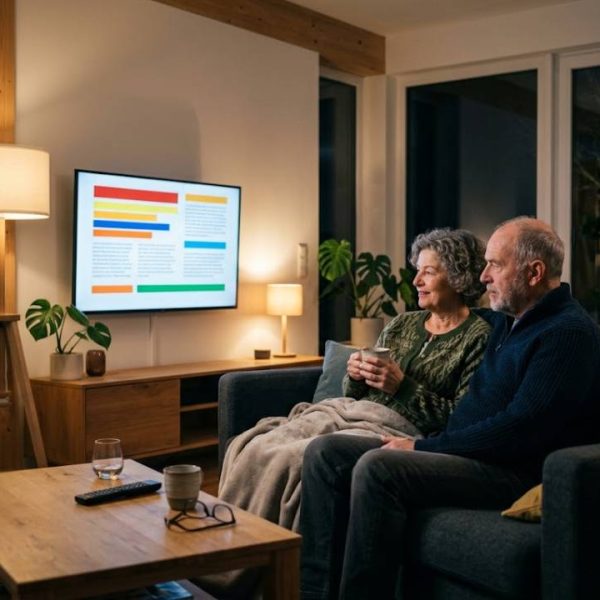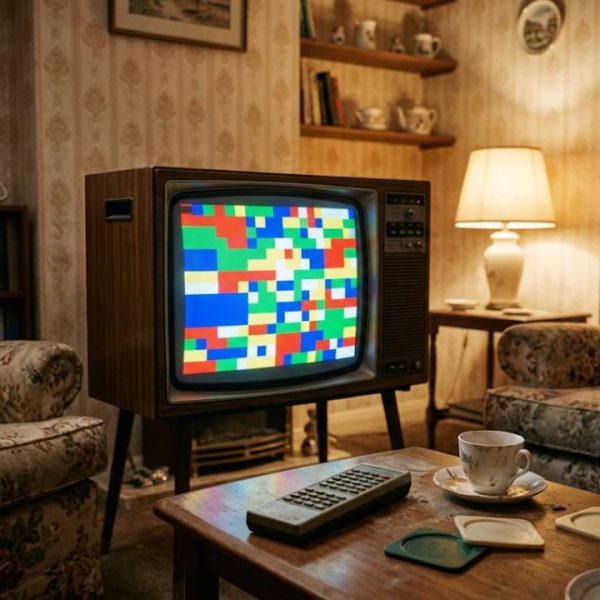
For anyone who grew up in Europe in the 1980s or 1990s, the ritual is familiar. You pressed the Text button on the remote, typed in a three-digit number and waited for blocky coloured letters to appear. Page 100 for the index, 101 for news, 302 for football results, 888 for subtitles. Teletext was the internet before the internet, and in several countries it never went away.
Understanding how teletext works says a lot about smart software design under tight constraints.
How teletext actually works
Analogue television pictures were transmitted line by line, with a short gap between frames called the vertical blanking interval. In the early 1970s, engineers at the BBC and the British Independent Broadcasting Authority realised they could hide digital data in those unused lines. The television set could then decode the data and display pages of text and simple graphics.
The BBC launched Ceefax in 1974, and ITV followed with ORACLE. Pages were broadcast in a continuous loop. When you typed a page number, your TV waited until that page came around in the cycle and then grabbed it. That is why some pages loaded instantly and others took several seconds.
Clever design under tight limits
Each teletext page holds 24 rows of 40 characters. Colours are limited to eight, and graphics are built from small mosaic blocks. Despite these limits, editors produced news, weather maps, TV listings, stock prices, holiday offers and even simple games.
The system was standardised across Europe through broadcasting bodies, and organisations like the European Broadcasting Union helped coordinate technical specifications so that sets from different manufacturers could read the same signals. National character sets were added so that German umlauts, French accents and Scandinavian letters could be displayed correctly.
Where text TV still lives
The UK switched off Ceefax in 2012 when analogue broadcasting ended. Elsewhere, teletext proved remarkably resilient. Germany's ARD Text and ZDFtext still attract millions of users. In the Netherlands, NOS Teletekst remains a familiar source of quick news, and public broadcasters in Denmark, Sweden, Norway, Finland and Austria continue to run text services, now delivered through digital broadcasting and online apps.
Why has it survived? It is fast, ad-light, works without an internet connection and presents news in short, factual chunks. For many older viewers it is simply a habit, and a reliable one.
Subtitles, the hidden legacy
One of teletext's most important contributions had nothing to do with news. Page 888 in the UK, and pages like 150 or 777 in other countries, carried subtitles for deaf and hard of hearing viewers. Teletext made closed captioning widely available across Europe long before streaming platforms existed.
That legacy lives on in modern subtitling workflows. Broadcasters now produce subtitles in several languages for the same programme, often under tight deadlines.
From teletext to multilingual content
Today's broadcasters and streaming services manage text in many languages: subtitles, programme guides, app interfaces, metadata and news tickers. German public broadcasters, for instance, produce content for audiences across German-speaking Europe and increasingly offer versions for international viewers. When German programmes are licensed abroad, scripts, subtitles and promotional texts often pass through professional german translation services to reach English-speaking markets.
For high-volume, time-sensitive content such as news tickers or live sports updates, broadcasters increasingly test a machine translation tool as a first step, followed by human editing. The approach mirrors teletext's original spirit: deliver short, accurate text quickly to as many people as possible.
Managing all of these language versions requires proper infrastructure. A web based translation management system lets editorial teams, subtitlers and translators work on the same content from different locations, track versions and publish updates across platforms without losing control of terminology.
The common thread is a technical standard that only works when the wording is exact and predictable. In regulated industries the stakes are higher, but the principle is the same: specialist technical translation services prepare device labels and user instructions so that every market gets text that satisfies its compliance rules. Teletext showed how much depends on getting short strings right the first time. More complex products simply add legal consequences to the same problem.
Lessons for software developers
Teletext is a reminder that great software does not need endless resources. Several of its design principles still matter in bespoke development today:
- Constraints breed clarity. Forty characters per line forced editors to write concisely.
- Predictable navigation works. Fixed page numbers meant users always knew where to go.
- Accessibility is a feature. Subtitles reached millions who would otherwise be excluded.
- Standards enable scale. Shared specifications let the system work across countries and brands.
- Offline still matters. Not every user is always connected.
Teletext art and nostalgia
In recent years, teletext has enjoyed a cultural revival. Artists create images using the original mosaic graphics, and festivals in Germany and the Nordic countries showcase teletext art on real television sets. Online emulators let anyone browse recreated historic pages, and hobbyists restore archived Ceefax pages from old video recordings.
What comes next
Hybrid broadcast standards such as HbbTV now let TV channels combine traditional broadcasting with internet content, and many modern text services run on this technology with better graphics and interactive features. Yet the basic idea remains the same: quick, structured information on the main screen in the living room.
Teletext proved that a simple, well-designed system can outlive the technology it was built on by decades. For developers designing software today, that is a goal worth aiming for.
For anyone who grew up in Europe in the 1980s or 1990s, the ritual is familiar. You pressed the Text button on the remote, typed in a three-digit number and waited for blocky coloured letters to appear. Page 100 for the index, 101 for news, 302 for football results, 888 for subtitles. Teletext was the internet before the internet, and in several countries it never went away.
For anyone who grew up in Europe in the 1980s or 1990s, the ritual is familiar. You pressed the Text button on the remote, typed in a three-digit number and waited for blocky coloured letters to appear. Page 100 for the index, 101 for news, 302 for football results, 888 for subtitles. Teletext was the internet before the internet, and in several countries it never went away.
Understanding how teletext works says a lot about smart software design under tight constraints.
How teletext actually works
Analogue television pictures were transmitted line by line, with a short gap between frames called the vertical blanking interval. In the early 1970s, engineers at the BBC and the British Independent Broadcasting Authority realised they could hide digital data in those unused lines. The television set could then decode the data and display pages of text and simple graphics.
Analogue television pictures were transmitted line by line, with a short gap between frames called the vertical blanking interval. In the early 1970s, engineers at the BBC and the British Independent Broadcasting Authority realised they could hide digital data in those unused lines. The television set could then decode the data and display pages of text and simple graphics.
The BBC launched Ceefax in 1974, and ITV followed with ORACLE. Pages were broadcast in a continuous loop. When you typed a page number, your TV waited until that page came around in the cycle and then grabbed it. That is why some pages loaded instantly and others took several seconds.
The BBC launched Ceefax in 1974, and ITV followed with ORACLE. Pages were broadcast in a continuous loop. When you typed a page number, your TV waited until that page came around in the cycle and then grabbed it. That is why some pages loaded instantly and others took several seconds.
Clever design under tight limits
Each teletext page holds 24 rows of 40 characters. Colours are limited to eight, and graphics are built from small mosaic blocks. Despite these limits, editors produced news, weather maps, TV listings, stock prices, holiday offers and even simple games.
Each teletext page holds 24 rows of 40 characters. Colours are limited to eight, and graphics are built from small mosaic blocks. Despite these limits, editors produced news, weather maps, TV listings, stock prices, holiday offers and even simple games.
The system was standardised across Europe through broadcasting bodies, and organisations like the European Broadcasting Union helped coordinate technical specifications so that sets from different manufacturers could read the same signals. National character sets were added so that German umlauts, French accents and Scandinavian letters could be displayed correctly.
The system was standardised across Europe through broadcasting bodies, and organisations like the European Broadcasting Union helped coordinate technical specifications so that sets from different manufacturers could read the same signals. National character sets were added so that German umlauts, French accents and Scandinavian letters could be displayed correctly.
Where text TV still lives
The UK switched off Ceefax in 2012 when analogue broadcasting ended. Elsewhere, teletext proved remarkably resilient. Germany's ARD Text and ZDFtext still attract millions of users. In the Netherlands, NOS Teletekst remains a familiar source of quick news, and public broadcasters in Denmark, Sweden, Norway, Finland and Austria continue to run text services, now delivered through digital broadcasting and online apps.
The UK switched off Ceefax in 2012 when analogue broadcasting ended. Elsewhere, teletext proved remarkably resilient. Germany's ARD Text and ZDFtext still attract millions of users. In the Netherlands, NOS Teletekst remains a familiar source of quick news, and public broadcasters in Denmark, Sweden, Norway, Finland and Austria continue to run text services, now delivered through digital broadcasting and online apps.
Why has it survived? It is fast, ad-light, works without an internet connection and presents news in short, factual chunks. For many older viewers it is simply a habit, and a reliable one.
Why has it survived? It is fast, ad-light, works without an internet connection and presents news in short, factual chunks. For many older viewers it is simply a habit, and a reliable one.
Subtitles, the hidden legacy
One of teletext's most important contributions had nothing to do with news. Page 888 in the UK, and pages like 150 or 777 in other countries, carried subtitles for deaf and hard of hearing viewers. Teletext made closed captioning widely available across Europe long before streaming platforms existed.
One of teletext's most important contributions had nothing to do with news. Page 888 in the UK, and pages like 150 or 777 in other countries, carried subtitles for deaf and hard of hearing viewers. Teletext made closed captioning widely available across Europe long before streaming platforms existed.
That legacy lives on in modern subtitling workflows. Broadcasters now produce subtitles in several languages for the same programme, often under tight deadlines.
From teletext to multilingual content
Today's broadcasters and streaming services manage text in many languages: subtitles, programme guides, app interfaces, metadata and news tickers. German public broadcasters, for instance, produce content for audiences across German-speaking Europe and increasingly offer versions for international viewers. When German programmes are licensed abroad, scripts, subtitles and promotional texts often pass through professional german translation services to reach English-speaking markets.
Today's broadcasters and streaming services manage text in many languages: subtitles, programme guides, app interfaces, metadata and news tickers. German public broadcasters, for instance, produce content for audiences across German-speaking Europe and increasingly offer versions for international viewers. When German programmes are licensed abroad, scripts, subtitles and promotional texts often pass through professional german translation services to reach English-speaking markets.
For high-volume, time-sensitive content such as news tickers or live sports updates, broadcasters increasingly test a machine translation tool as a first step, followed by human editing. The approach mirrors teletext's original spirit: deliver short, accurate text quickly to as many people as possible.
For high-volume, time-sensitive content such as news tickers or live sports updates, broadcasters increasingly test a machine translation tool as a first step, followed by human editing. The approach mirrors teletext's original spirit: deliver short, accurate text quickly to as many people as possible.
Managing all of these language versions requires proper infrastructure. A web based translation management system lets editorial teams, subtitlers and translators work on the same content from different locations, track versions and publish updates across platforms without losing control of terminology.
Managing all of these language versions requires proper infrastructure. A web based translation management system lets editorial teams, subtitlers and translators work on the same content from different locations, track versions and publish updates across platforms without losing control of terminology.
Lessons for software developers
Teletext is a reminder that great software does not need endless resources. Several of its design principles still matter in bespoke development today:
- Constraints breed clarity. Forty characters per line forced editors to write concisely.
- Predictable navigation works. Fixed page numbers meant users always knew where to go.
- Accessibility is a feature. Subtitles reached millions who would otherwise be excluded.
- Standards enable scale. Shared specifications let the system work across countries and brands.
- Offline still matters. Not every user is always connected.
Teletext art and nostalgia
In recent years, teletext has enjoyed a cultural revival. Artists create images using the original mosaic graphics, and festivals in Germany and the Nordic countries showcase teletext art on real television sets. Online emulators let anyone browse recreated historic pages, and hobbyists restore archived Ceefax pages from old video recordings.
In recent years, teletext has enjoyed a cultural revival. Artists create images using the original mosaic graphics, and festivals in Germany and the Nordic countries showcase teletext art on real television sets. Online emulators let anyone browse recreated historic pages, and hobbyists restore archived Ceefax pages from old video recordings.
What comes next
Hybrid broadcast standards such as HbbTV now let TV channels combine traditional broadcasting with internet content, and many modern text services run on this technology with better graphics and interactive features. Yet the basic idea remains the same: quick, structured information on the main screen in the living room.
Hybrid broadcast standards such as HbbTV now let TV channels combine traditional broadcasting with internet content, and many modern text services run on this technology with better graphics and interactive features. Yet the basic idea remains the same: quick, structured information on the main screen in the living room.
Teletext proved that a simple, well-designed system can outlive the technology it was built on by decades. For developers designing software today, that is a goal worth aiming for.
Teletext proved that a simple, well-designed system can outlive the technology it was built on by decades. For developers designing software today, that is a goal worth aiming for.